
On Becoming a Knight 5
Fight Often, Fight Anywhere

I. Do You Know the Way to San Jose?
If there’s one thing that the recent “Game of Thrones” spinoff series “A Knight of the Seven Kingdoms” conveys well, it is the sense of Sir Dunk the Knight’s Journey has both metaphysical and physical elements, but a big part of the metaphysical comes directly out of the very real physical necessities that come with knighthood: namely, resources. Resources sufficient to pay for a kit in the first instance, to care for and maintain horses for travel, lodgings while traveling, fees to fight at tournaments, means to maintain armor and weapons against wear and tear… in this sense, a knight’s physical story unfolds across both time and space with a grand scale that also includes the quotidien demands of earning a livelihood, no matter how humble its origins, nor how close to being at the minimum acceptable standard it is and still be worthy to claim the title. This is what made knights mostly the toughest of the highborn, if we’re being honest, but it’s also a big part of what gives “A Knight of the Seven Kingdoms” its rare charm. Sir Dunk is like Bunyan’s “Christian” in what is one of the greatest of Christian allegories, The Pilgrim’s Progress. Dunk is an everyman - even lower than that, in truth - an orphan raised by a bibulous knight who could hardly be called chivalric in any real sense of the word… And yet…
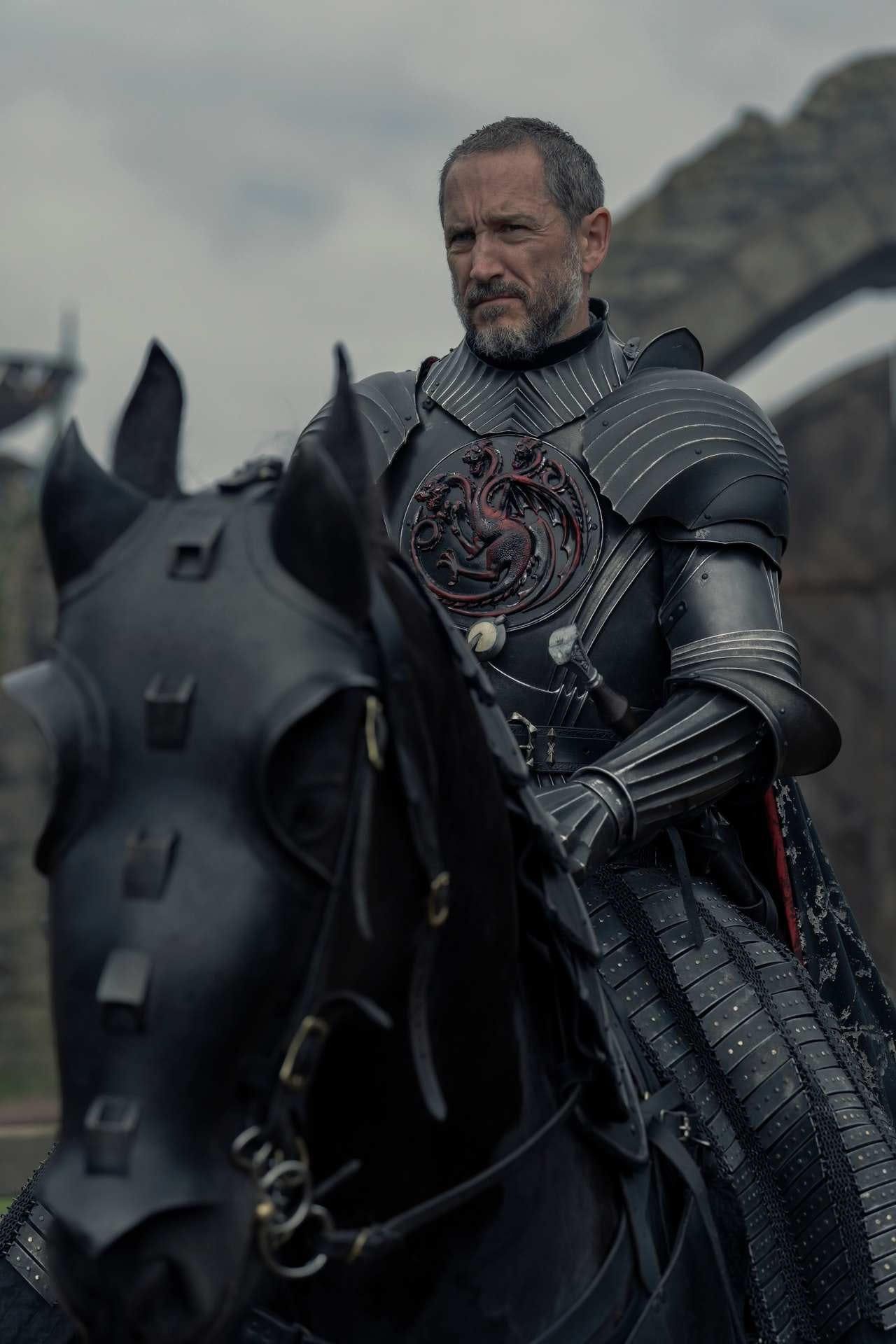
Dunk’s simple sense of what it means to be noble - to defend the weak, those who cannot defend themselves - even while watching a drunkard make a meager attempt at living up to it, takes him a pretty long way to capturing the essence of what chivalry demands of a knight, even if he lacks an understanding of the fullness - and more arcane rules - that can come with being a “real” knight. This is what makes Baelor “Breakspeare” Targaryen the true, tragic hero of the show.1 Baelor represents what a high born knight should be, not merely the titles of nobility, but the actual virtues of character of fully-realized nobility in both deed and word, distinction in battle, wisdom in counsel, and honor in siding even against his own brother in defense of the spark that burns in Ser Duncan to be a Good Knight, by being a Good and Honorable Man.
While I’m certainly not of noble birth, being a lawyer did give me sufficient means to be able to travel to fight in armor. And I feel it must be noted that in all the subsequent centuries since the times of Nine Worthies, it still costs no small amount of money, time, and resources to schlep 80 pounds of armor and weapons around in a snowboard and Cabela’s bag on major airlines. I was very fortunate to have the ability to do it and so it allowed me to fight often.
Pro-tip: whatever you do, when you are traveling with blunted, medieval pole-arms, and/or swords, and armor in your checked baggage, it shall ALWAYS be referred to (with airline AND TSA personnel) as “sports equipment” or “gear” or any other safe-sounding euphemism, and NEVER should the word “weapon” or “weaponry” escape from thine piehole, lest thou desirest greatly what they callest “secondary” and thou shouldst misseth all thine connections from now tillst eternity.
It is also worth noting that you should expect fighting in harness to turn you into a mini-armorer of sorts, by necessity. You will need to learn to hammer out rivets, different uses for different kinds of hammers, how to put punched steel plates onto leather, and to keep a nice stock of salvage buckles and straps. This is because it’s not long before you observe that there are only two kinds of Knights: the first kind are (perhaps) capable fighters (or not), but regardless of ability, they simply can’t keep themselves on the field of battle for any length of time because their kit (inevitably) has a broken buckle, or a strap that tears off, and they’re forced to go find someone who can repair it while the battles rage on without them. The second kind of Knight doesn’t make excuses for what he needs and doesn’t have: and while tons of money can make up for some deficiencies, it’s not a cure-all for buying away problems. Acquiring the skills necessary to keep yourself in trim when weather, conditions, or other circumstances won’t allow the full logistics train you might like or even be able to afford is also a big part of being a Knight. Deeds, not words (or dollars).
II. A Religious Experience in Montreal
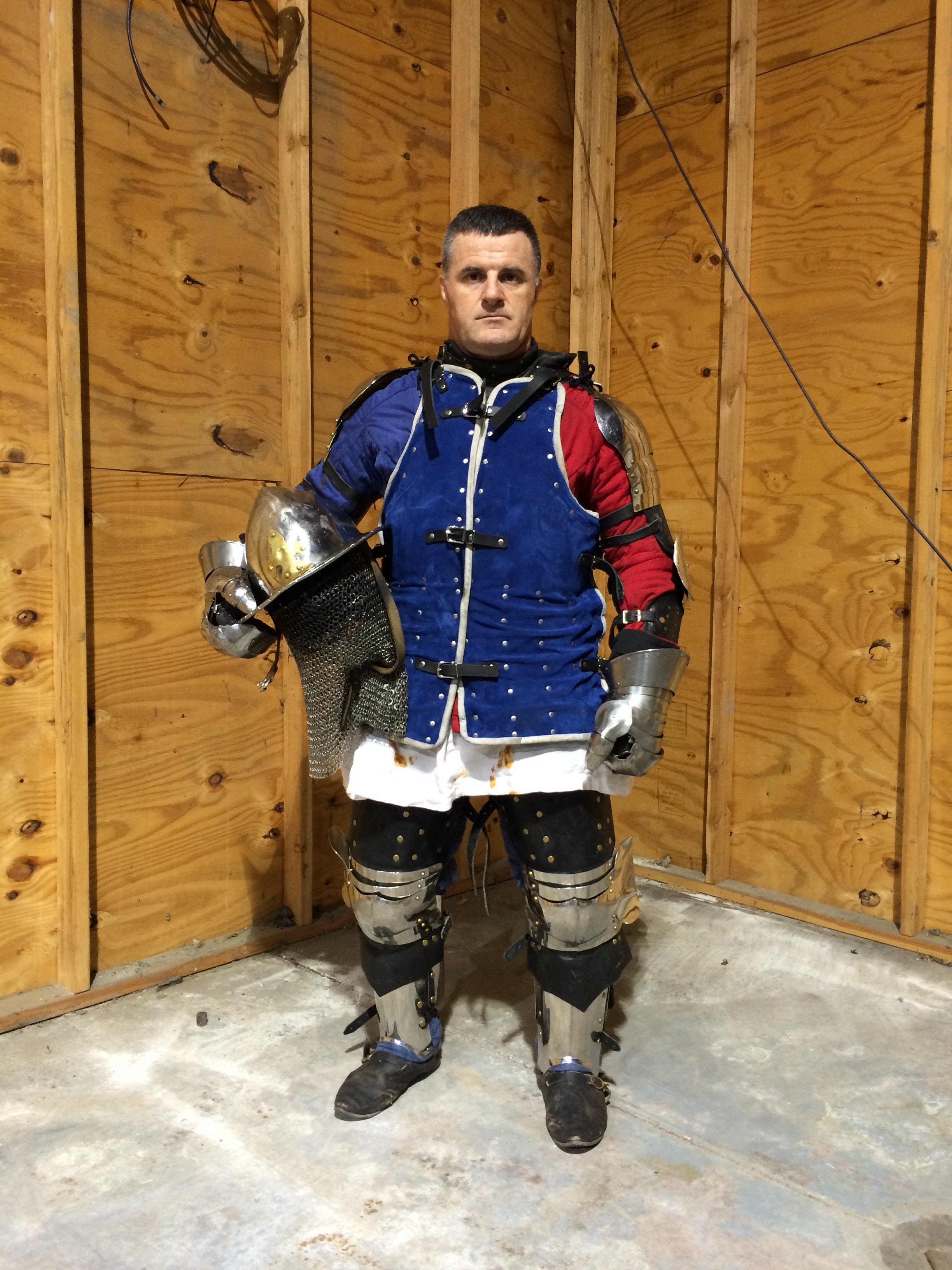
In perhaps six months of fighting, by February 2014, I was already making some changes to my kit. I first tried out my new coat-of-plates (pictured above) in a local bout of fighting in San Jose, CA. While I had come to love my trusty, reliable late-1400’s version of the Visby/Wisby coat, the slightly more-modern (early 1500s) version, in Elvis Presley’s suede shoes blue with the fauldes at the bottom that gave my legs a lot more freedom of movement (if less protection), was too sexy not to get. This was in anticipation of what would be my first “international” experience - traveling to the Great White North for a tournament in Montreal, Canada, held during the city’s annual Winter Carnival.



Fortunately, we didn’t fight in the cold, but instead - in fine medieval tradition - smote each other in the basement of a catholic church, Église Saint-Enfant-Jésus du Mile-End. I have no pictures from the fighting, so all I could dig up was the below video. While I was upgrading my kit, I was also experimenting with preferred weapons. In the fight below, I try my hand (unsuccessfully) with a bardiche. A wicked looking weapon, but to my mind it was better for defense and less effective at offense. Here it wouldn’t have mattered what we used: we could have used shovels or giant q-tips, because I was fighting the best axe-man the US has ever had, Sir Jeff Galli.
There’s a retired hockey fighter who is fond of joking that in some of his fights in the NHL against other tough guys he “came in third.” I came in third repeatedly against Jeff over the years, but he was a great friend, mentor, and inspiration on my journey to knighthood. He was just so damn good on his feet and he could wield a polearm like few people. Because we were teammates, when we both made the finals from our separate brackets, he only “lightly” tuned me up - a small snippet starts at 0:52 of this clip.
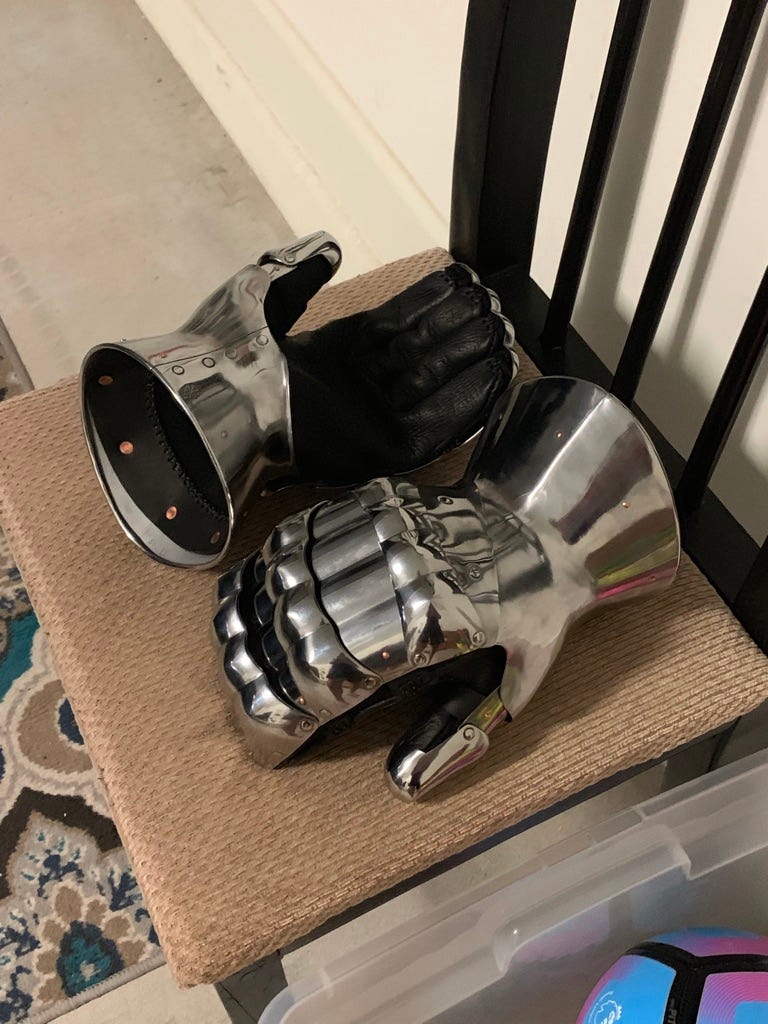
Pro-tip: fighting with two-handed weapons, be it longsword, or a polearm, i.e. anything where you don’t have a shield: it doesn’t matter how good your gauntlets are, whether they are custom-made functional objets d’art like the famed gauntlets of Grettir T. Slow, pictured below,
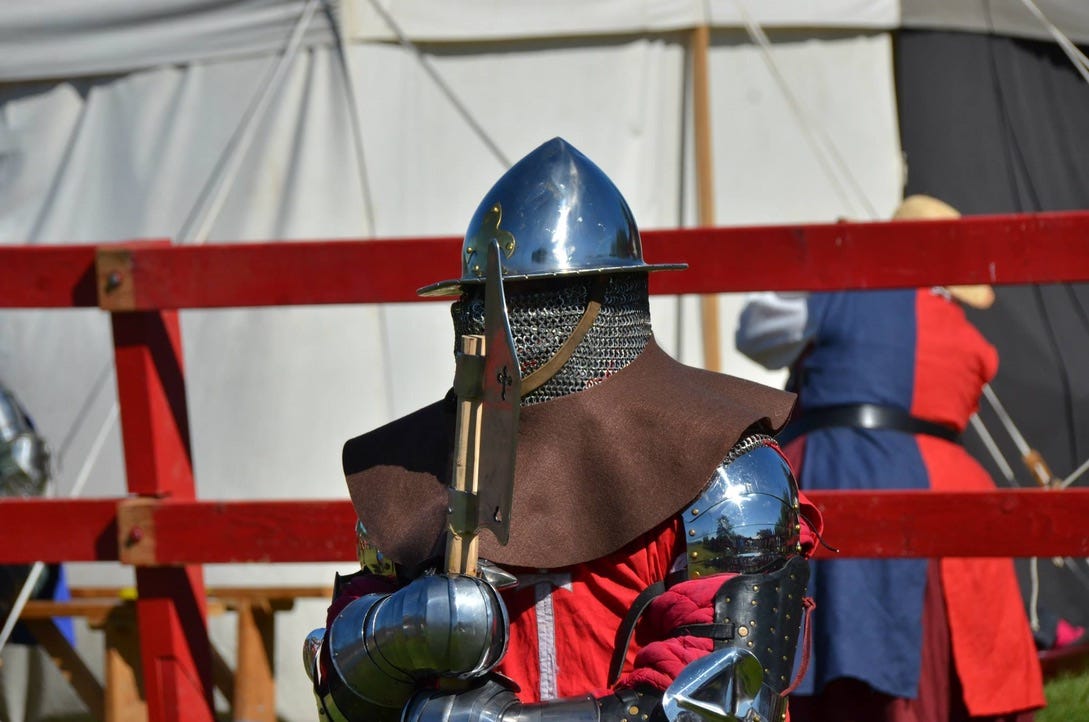
Or more simple clamshell (mitten) gauntlets that I was using in my first tournament (pictured below),
Regardless, no matter how good they are, there is nothing that can change the cold reality that (1) as surely as night follows day, you will get your hand smashed by someone else’s axe, or voulge, or longsword, (2) very likely several times in the course of a weekend tournament, and (3) it feels very much like getting your hand/fingers closed in a car door. No serious pianist or harpist in their right mind should ever consider regular participation with two-handed weapons in this sport.
In the same way that Sean Bean’s Ned Stark was the early tragic hero of George R.R. Martin’s ongoing obsession with proving that only the good die young.
Wait, what?! The knights of old weren’t useless fops and brutes? They had to be industrious, competent, practical, and thrifty, as well as disciplined and brave? Who could imagine it?
As a one-time framing carpenter, there’s a certain special something about mashing the end of your thumb with a hammer first thing on a cold November morning that puts me in mind of your description of wielding two-handed weapons. After you’ve evaluated the spreading bruise under the nail, you put your glove back on and hope like hell you don’t hit again over the next 8 hours of the work day.
<whisper> You do.